
Correctness: How We Build Distributed Systems Correct
The recent work on Rings had a simple center of gravity: move correctness for the distributed system and the cryptography back into explicit mathematical structures.
A lot of engineering changed around it: tests, encryption, storage, routing, runtime behavior, and release mechanics. The common thread was algebraic semantics: objects, operations, and state transitions should be things we can state, check, and compose.
The name Rings already points in this direction. Chord gives us an identifier space that is naturally circular. Nodes and resources are mapped into a fixed-width set of identifiers, and successor, predecessor, finger, distance, and interval logic all live inside that space. If we write the space as Z/2^mZ, the usual wrap-around behavior of Chord becomes ordinary modular arithmetic.
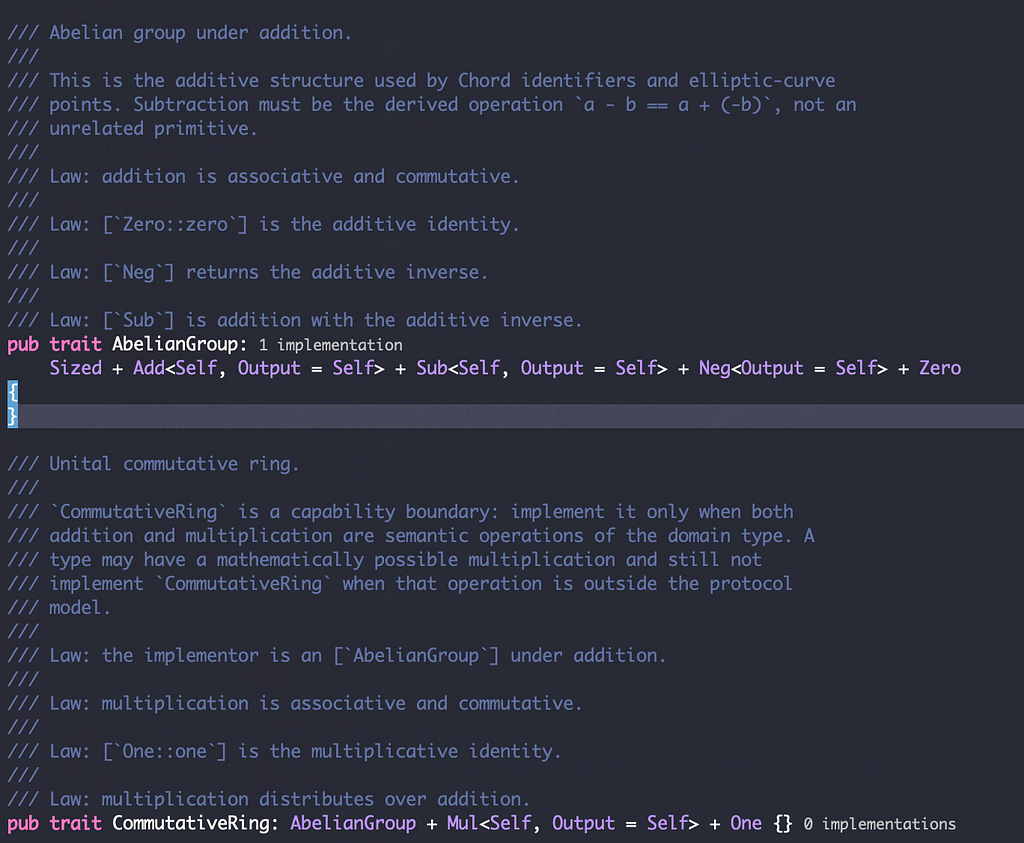
In abstract algebra, a ring is a set with two operations, usually called addition and multiplication. The additive part forms an Abelian group: associativity, commutativity, an identity, and inverses. Multiplication is associative, and multiplication distributes over addition. Groups, rings, and fields form a useful ladder of structure: a group gives one reversible operation; a ring adds multiplication and distributivity; a field makes every nonzero element multiplicatively invertible.
This ladder appears all over cryptography. Elliptic-curve points form Abelian groups. Scalars come from finite fields. Scalar multiplication is a module action of field elements on group elements. Signatures, key exchange, ElGamal, secret sharing, and polynomial interpolation all depend on some combination of group laws, field inverses, and module actions. Once the underlying type correctly implements the law, protocol code can depend on the structure, with curve-specific details confined to adapters.
That is the point of algebra.rs. Traits such as Magma, Semigroup, Monoid, Group, Ring, Field, and Module collect isomorphic structures that used to be scattered through the codebase. They say which operations a type supports, which laws those operations are expected to satisfy, and which properties higher layers may rely on. For Rings, this semantic boundary matters more than another pile of helper functions.
Before this work, Rings had several cryptographic paths: secp256k1, secp256r1, BLS12–381, Ristretto255, and the Ed25519 and ECDSA variants needed by provider login flows. These serve different ecosystems, but mathematically they rhyme. The algebraic abstraction lets us put elliptic-curve groups under one group, field, and module vocabulary. Curve adapters satisfy the laws; protocols consume the laws.
The ElGamal rewrite is a concrete example. ECC ElGamal is lifted onto cyclic-group abstraction. Malformed ciphertexts, nonce freshness, scalar multiplication, and public-key validation move to the layer where their mathematical meaning is clear. Streaming E2E ElGamal then carries this structure up to the communication layer: public-key discovery, DID ownership, signed handshakes, and encrypted message sending form a path from group law to encrypted transport.
The distributed-system side follows the same pattern. Distributed state is hard because it is copied, delayed, replayed, partitioned, repaired, and merged. A state model that depends on a single arrival order is uncomfortable in an asynchronous network. Rings uses a CRDT join-semilattice to describe Entry storage: state merge is given by join, and join is associative, commutative, and idempotent. Duplicate messages, reordered messages, and multi-path repair all converge to the same least upper bound.
Entry becomes the carrier for replicated state. Copy, ack, conditional delete, anti-entropy, and read-repair can be understood inside one monotone framework. If every state transition moves upward in the order, then post-partition merge is explained by join, and eventual consistency can be stated as a semilattice property. The mathematics here is part of durable storage, not a comment next to it.
Chord topology gives us another mathematical object: a process that moves toward a fixed point. Each node updates successor, predecessor, and finger knowledge from local observations. These local updates compose into a global topology evolution. Under the right constraints, stabilization is a monotone transition system moving toward a stable ring. Once Correct Chord is the default, finger tables, successor lists, join, and rectify all serve this shared model.
To make the model testable, Rings pushes core logic toward pure transitions. Pure functions describe how state changes. Effects describe what must happen in the outside world. Payload relay, message send, connection operation, and DHT action become effect functors, then join an effect coproduct, and an outer interpreter executes them. Core semantics can then be tested and modeled separately from I/O.
Functor here means structure preservation: an effect can be mapped and composed while keeping its semantic shape. The monadic intuition is sequencing with context: one result determines the next action, and the state/effect flow is constrained by types. Rust does not need to pretend to be Haskell. The useful thing is that effect boundaries, composition order, and interpreter responsibilities become forms we can reason about.
The testing story follows from this. Asynchronous correctness cannot get much confidence from fixed sleeps. Rings moves convergence, stabilization, and routing tests toward state predicates, controlled schedules, and finite-state models. The interesting question changes from “did it look okay after waiting?” to “under this transition system and this schedule, did the invariant hold, and did the system move toward the target fixed point?”
So the 2026Mid correctness work can be summarized as three mathematical paths. The cryptographic path uses groups, fields, and modules to unify curves and protocols. The replicated-state path uses join-semilattices and CRDT laws to express storage merge and repair. The distributed-execution path uses pure transitions, effect functors, effect coproducts, and monotone fixed points to describe topology evolution and side-effect interpretation.
Together, these paths change the acceptance bar for Rings. An implementation should explain the algebraic structures it relies on. A state object should explain its invariant. An effect should explain its boundary. A test should witness the property it claims. The goal of Rings 2026Mid correctness is a system that remains explainable, testable, and provable under asynchrony, failure, duplication, reordering, weak resources, and multiple platforms.